
Stormwater Sampling: NPDES Compliance & Outfall Monitoring
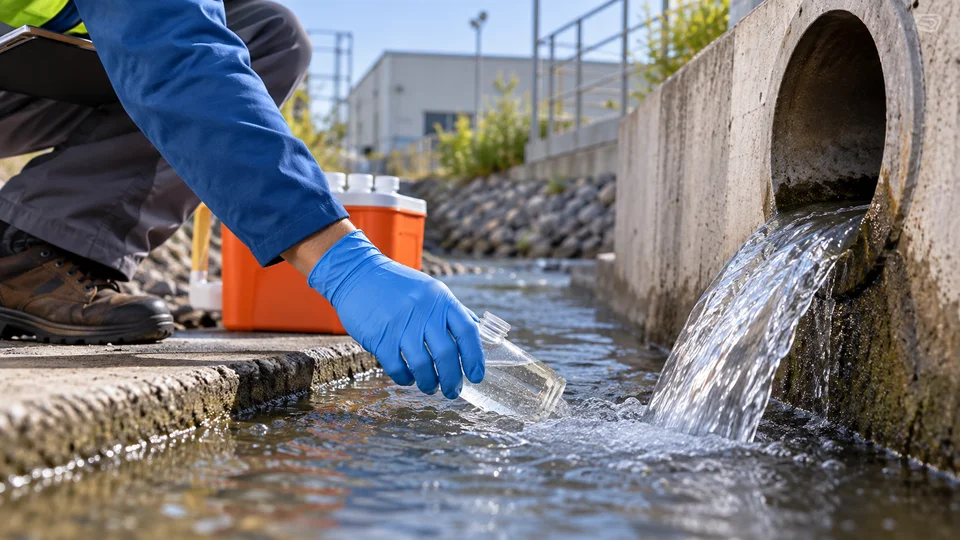
If your facility has an industrial NPDES stormwater permit, you are required to sample your discharge. Most facilities have the permit. Most are not sampling correctly. Some are not sampling at all. This is one of the most commonly cited environmental violations in industrial operations, and it compounds every year you skip it. The penalties are real, the paperwork is specific, and the excuses inspectors have heard a thousand times will not help you.
Stormwater sampling involves collecting water samples from your facility's discharge points (outfalls) during qualifying rain events and submitting the analytical results to your state permitting authority. The parameters you test for depend on your industrial sector and your specific permit conditions. Get any part of that wrong and the sample does not count.
The Multi-Sector General Permit (MSGP)
EPA's MSGP covers 29 industrial sectors, each with its own monitoring requirements. Your sector classification determines which parameters you sample for, what benchmark values apply, and how frequently you must monitor. Getting your sector classification wrong means you are testing for the wrong things.
Sector A (timber products) monitors for COD and TSS. Sector C (chemical manufacturing) monitors for TSS, COD, nitrate/nitrite, and sometimes specific chemicals depending on sub-sector. Sector D (asphalt paving and roofing) monitors for TSS and pH. Sector N (scrap recycling) monitors for TSS, COD, aluminum, iron, lead, zinc, and copper. Sector S (vehicle maintenance) monitors for TSS, oil and grease, pH, and sometimes COD. Each sector has specific benchmark concentrations that trigger escalating compliance actions when exceeded.
Some sectors have numeric effluent limits in addition to benchmarks. These are hard limits, not targets. Exceeding a numeric effluent limit is an immediate permit violation, not a trigger for corrective action. Know the difference.
State-Specific Permit Variations
Many states operate their own industrial stormwater general permits instead of using the federal MSGP. California, Texas, Ohio, Pennsylvania, New York, and dozens of other states have their own versions. State permits often have different monitoring parameters, different benchmark values, different reporting deadlines, and different corrective action requirements than the federal MSGP. Some are stricter. A few are less prescriptive. You cannot assume the federal MSGP requirements apply to your facility unless your state specifically uses the federal permit.
California's Industrial General Permit, for example, has a two-tier benchmark system with Numeric Action Levels (NALs) that can trigger mandatory treatment requirements. Texas requires benchmark sampling only during the first year of permit coverage if results are below benchmarks. Ohio has its own benchmark values that differ from federal numbers. Check your actual permit. Not a summary of it. The actual permit document.
Qualifying Storm Event Criteria
You cannot just grab a sample any time it rains. A qualifying storm event has specific requirements that must be met, or the sample is invalid and you have wasted your time and lab fees.
Minimum rainfall: The event must produce at least 0.1 inches of precipitation. Light mist and drizzle that does not generate runoff from your industrial areas does not count. You need actual measurable rainfall that creates discharge at your outfalls.
Antecedent dry period: There must be at least 72 hours (3 days) of dry weather before the storm event. This ensures you are capturing the first flush of pollutants that accumulate on surfaces between rain events, not sampling diluted runoff from a multi-day rain pattern. Some state permits allow a shorter antecedent dry period of 48 hours. Check your specific permit.
First flush timing: Grab samples must be collected within the first 30 minutes of discharge at the outfall. Not 30 minutes after rain starts. Thirty minutes after discharge begins at the outfall you are sampling. This distinction matters because there is a lag between when rain starts falling and when runoff reaches your outfall, especially at larger sites. If you miss the 30-minute window, the sample does not meet permit requirements.
In practice, this means someone needs to be on site during the first qualifying storm of the monitoring period, ready to collect samples the moment discharge starts. This is why many facilities hire sampling services. Catching that 30-minute window during business hours on a weekday after 72 hours of dry weather is harder than it sounds.
Sampling Equipment and Techniques
Proper sample collection requires the right containers, preservatives, and handling procedures. Getting this wrong invalidates results and wastes an entire qualifying storm event.
Sample bottles are provided by the laboratory and are specific to each parameter. TSS samples go in plastic containers. Oil and grease samples go in glass containers with no headspace. Metals samples go in acid-preserved plastic containers. Never substitute containers or use field-rinsed bottles. The lab pre-cleans and preserves each container for its specific analysis.
Chemical preservatives are already in the bottles for parameters that require them. Metals bottles contain nitric acid to prevent adsorption to container walls. Some volatile organic compound bottles contain sodium thiosulfate to neutralize residual chlorine. Do not add anything to the bottles. Do not rinse them. Collect the sample directly into the bottle the lab provides.
Chain of custody (COC) documentation travels with the samples from collection to lab. Record the sample date, time, location (outfall ID), collector name, and parameters requested. Sign and date the COC when you hand samples to the courier or drop them at the lab. The lab signs when they receive them. A broken chain of custody can invalidate results in an enforcement action.
Field measurements for pH and temperature must be taken at the time of sample collection, not at the lab. Use a calibrated field pH meter and a thermometer. Record both on the COC and in your monitoring records. pH has a holding time of 15 minutes for regulatory samples, which means the lab cannot measure it. You must measure it in the field.
Holding times vary by parameter. TSS must reach the lab within 7 days. Oil and grease within 28 days. Metals within 180 days (if preserved). BOD within 48 hours. Miss a holding time and the result is not reportable. Plan your courier or shipping schedule before the rain starts.
Benchmark Exceedance Procedures
Exceeding a benchmark is not an immediate permit violation, but it triggers a compliance escalation you cannot ignore. The MSGP uses a tiered corrective action system that gets progressively more restrictive.
Tier 1: If any benchmark is exceeded, you must review your SWPPP, identify the likely source of the exceedance, and implement additional BMPs or modify existing ones. You document these actions in a corrective action report and continue monitoring. This is the mildest response, but it requires documented action within 14 days of receiving the lab results.
Tier 2: If benchmarks are exceeded in a subsequent monitoring period after implementing Tier 1 corrective actions, you must conduct a more thorough investigation, install additional structural or treatment BMPs, and develop an enhanced monitoring schedule. At this point, you are likely spending real money on stormwater infrastructure.
Tier 3: If benchmarks continue to be exceeded after Tier 2 actions, EPA or your state authority may impose numeric effluent limits on your facility. Numeric limits turn benchmark parameters into hard discharge limits. Exceeding a numeric limit is a direct permit violation with penalties. At this stage, you may need engineered treatment systems costing $50,000 to $500,000+ depending on the pollutants and flow volume.
Here is a real scenario. A metal fabrication facility in the Midwest exceeded TSS benchmarks (100 mg/L) for four consecutive quarterly sampling events. The first quarter came back at 180 mg/L. They did nothing. The second quarter came back at 220 mg/L. They added a silt fence. The third quarter came back at 165 mg/L. The fourth quarter hit 195 mg/L. The state imposed numeric TSS limits of 100 mg/L and required monthly monitoring instead of quarterly. The facility had to install a stormwater settling basin and filtration system at a cost of $85,000. The entire problem started because an uncovered scrap storage area was contributing sediment to runoff. A $3,000 cover structure in year one would have prevented $85,000 in treatment costs plus $12,000 per year in additional monitoring.
No Exposure Certification (NEC)
If all of your industrial activities and materials are completely sheltered from rain, you may qualify for a No Exposure Certification. An NEC exempts your facility from MSGP monitoring requirements. You must certify (and be able to demonstrate during inspection) that no industrial materials, activities, or equipment are exposed to stormwater at any time. This includes raw materials, intermediate products, finished products, waste materials, machinery, and industrial processes.
The NEC must be re-certified every five years. If an inspector finds any industrial exposure during a site visit, your NEC is revoked and you must immediately obtain permit coverage and begin monitoring. NECs work well for fully enclosed manufacturing operations. They do not work for facilities with outdoor storage, loading docks open to the elements, or outdoor vehicle maintenance areas.
Annual Comprehensive Site Compliance Evaluation
Your permit requires at least one comprehensive site inspection per year. This is not the same as routine visual monitoring. The annual evaluation requires a thorough walk-through of the entire facility to assess whether the SWPPP accurately reflects current site conditions, whether BMPs are properly installed and maintained, whether any new pollutant sources have been introduced, and whether monitoring data indicates compliance problems. The evaluation must be documented in a written report and kept with your SWPPP. Many facilities skip this or treat it as a checkbox. Inspectors always ask for the annual evaluation report.
Record Keeping Requirements
Keep all stormwater records for a minimum of 3 years from the date of the monitoring event. Some states require 5 or 6 years. Records include monitoring data, lab reports, chain of custody forms, DMR copies, visual monitoring logs, SWPPP documents and amendments, corrective action reports, annual evaluation reports, and training records. Electronic records are acceptable in most states, but keep paper originals of signed COC forms and manifests.
DMR submission has shifted to electronic in most states via the EPA NetDMR system or state-specific portals. Paper DMRs are still accepted in a few jurisdictions but are being phased out. Electronic submission creates an automatic compliance record, which means late or missed submissions are immediately flagged. There is no hiding a missed DMR in an electronic system.
What It Costs
SWPPP development: $2,000 to $5,000 for initial preparation. Updates and amendments run $500 to $2,000.
Per-event sampling: $300 to $800 per outfall per event, including sample collection, lab analysis, and reporting. A facility with three outfalls sampled twice per year pays $1,800 to $4,800 annually for benchmark monitoring.
Full compliance program: Annual stormwater compliance packages that include SWPPP maintenance, sampling, DMR preparation and filing, visual monitoring, and annual site inspections run $3,000 to $8,000 per year depending on facility size and outfall count.
Compare those costs to penalties of $25,000 to $65,000+ for permit noncompliance. Read our article on stormwater sampling compliance for a detailed breakdown of how violations accumulate and what enforcement looks like.
Need stormwater sampling services? Find environmental services companies in our provider directory.