
SPCC Plans: Spill Prevention, Control & Countermeasure
If your facility stores more than 1,320 gallons of oil in aboveground containers, federal law requires you to have an SPCC plan. That threshold is lower than most people think. A single 1,000-gallon diesel tank and a 500-gallon used oil tank puts you over it. Two 275-gallon totes of hydraulic fluid plus a 1,000-gallon fuel tank gets you there. The math adds up fast, and EPA counts every container 55 gallons or larger.
The SPCC rule (40 CFR Part 112) falls under the Clean Water Act and applies to any facility that could reasonably discharge oil into navigable waters or adjoining shorelines. The plan is a site-specific document that describes your oil storage, your prevention measures, your containment systems, and your emergency response procedures. It is not a template you download and fill in. It is an engineered, site-specific compliance document.
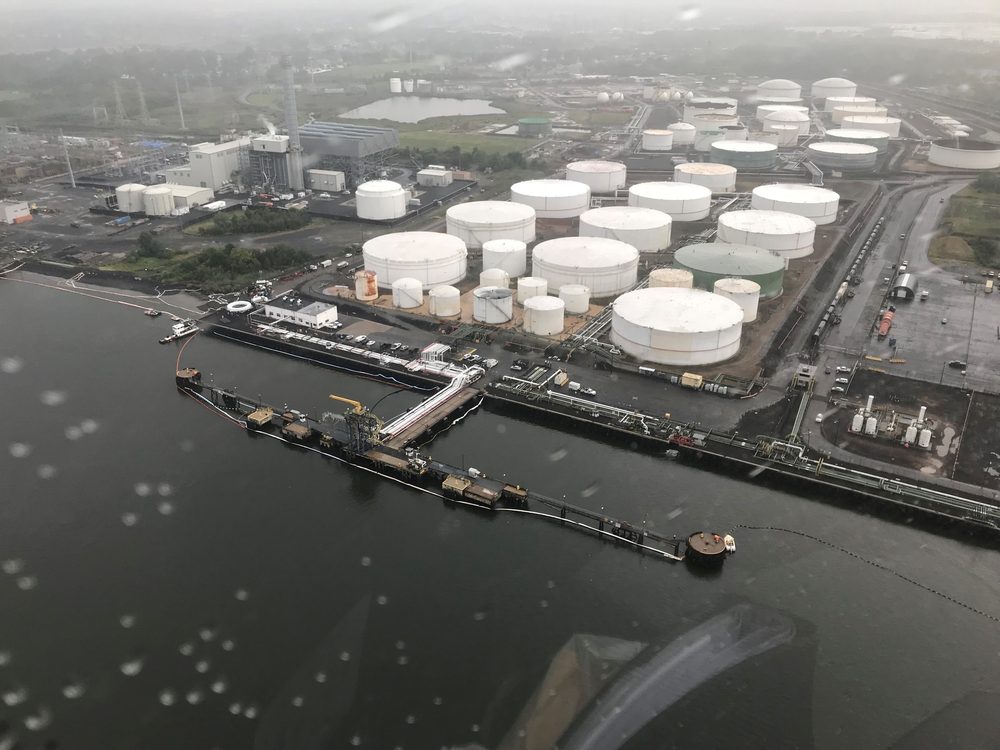
Threshold Analysis: Do You Actually Need One?
The aboveground threshold is 1,320 gallons total in containers of 55 gallons or larger. You count every type of oil at your facility. Not just fuel tanks. Every container of petroleum, diesel, gasoline, jet fuel, hydraulic fluid, lubricating oil, vegetable oil, animal fat, transformer oil, mineral oil, synthetic oil, waste oil, cutting oil, heat transfer oil, and any other oil as defined under the Clean Water Act. That transformer behind your building with 200 gallons of mineral oil counts. The 55-gallon drums of hydraulic fluid in your maintenance shop count. The used oil collection tank in your garage counts.
The underground threshold is 42,000 gallons total. This applies to buried tanks that are not regulated under a state UST program. Most underground storage tanks at gas stations and fuel depots are already regulated under the UST rules (40 CFR 280) and do not count toward SPCC thresholds. But buried process tanks, underground piping, and certain other underground storage may trigger the SPCC requirement.
Count everything. Walk your facility with a clipboard. Open every mechanical room. Check every outbuilding. Facilities routinely undercount their oil storage because they forget about hydraulic equipment, transformer oil, compressor lubricant reservoirs, and drums stored in back corners of warehouses. If your total exceeds 1,320 gallons aboveground, you need a plan. Period.
Tier I and Tier II Self-Certification
Not every facility needs a Professional Engineer to certify the plan. EPA created two self-certification tiers for smaller, lower-risk facilities.
Tier I qualified facilities have total aboveground oil storage capacity of 10,000 gallons or less AND have had no single discharge exceeding 1,000 gallons or no two discharges exceeding 42 gallons each within any 12-month period in the three years prior. A Tier I facility can use the EPA template (Appendix G to 40 CFR 112) and self-certify without a PE. This is the simplest path, but the template is rigid and the eligibility requirements are strict.
Tier II qualified facilities meet the same spill history requirements as Tier I but have total aboveground storage capacity over 10,000 gallons. Tier II facilities can self-certify a plan they prepare themselves, but the plan must address all the technical requirements of 40 CFR 112. This is not the EPA template. This is a full SPCC plan without the PE stamp. Many facilities that attempt Tier II self-certification produce plans that are incomplete because they do not understand the technical requirements.
If your facility does not qualify for Tier I or Tier II, or if you have any spill history, you need PE certification. Most industrial facilities end up needing the PE.
PE Certification: What the Engineer Actually Does
The PE does not just stamp your plan. A Professional Engineer who certifies an SPCC plan is attesting that they have examined the facility, evaluated the oil storage and handling operations, reviewed the plan contents, and confirmed that the plan is adequate for the facility. That PE is putting their professional license on the line. They assume personal liability for the adequacy of the plan.
Specifically, the PE reviews and certifies that secondary containment is properly sized and maintained, that drainage controls are adequate, that integrity testing programs are appropriate for the container types present, that loading and unloading procedures are sufficient, that the facility diagram accurately represents the site, and that spill response procedures are realistic and executable. The PE must physically visit the site. A PE who certifies a plan without visiting the facility is violating professional engineering ethics and potentially committing fraud.
PE certification costs between $2,000 and $5,000 on top of the plan preparation cost, depending on facility complexity. It is not optional for facilities that do not qualify for self-certification.
Secondary Containment Requirements
The 110% / 10% rule is the foundation of SPCC containment. Secondary containment for each storage area must hold the volume of the largest single container within the area plus sufficient freeboard for precipitation, OR 10% of the total volume of all containers in the area, whichever is greater. This applies to dikes, berms, containment walls, and any other passive containment structure.
Passive vs. active drainage changes your compliance obligations significantly. Passive drainage means stormwater accumulates in the containment area and evaporates or is manually removed. Active drainage means you have a valve or pump that drains accumulated rainwater out of the containment. If you use active drainage, the SPCC plan must include procedures for inspecting the accumulated water before release, verifying it is not contaminated, and documenting the inspection. The drain valve must be locked closed at all times when not actively draining inspected water. Open drain valves in secondary containment are one of the most common SPCC violations inspectors find.
Rainwater management is the part everyone underestimates. In areas with significant rainfall, containment structures fill up. If you do not manage rainwater, your containment has zero capacity when a spill actually occurs. Your plan must address how you manage accumulated precipitation. Many facilities install sump pumps with oil/water detection interlocks, but the simplest solution is a locked manual drain valve with a written inspection procedure.
Integrity Testing
Every container in your plan needs an integrity testing program appropriate to its type. For large aboveground storage tanks (ASTs), API 653 is the standard for inspection. It includes external visual inspection, ultrasonic thickness (UT) testing of the shell and floor, and assessment of foundation and support structures. For smaller shop-fabricated tanks, STI SP001 provides the inspection framework. Ultrasonic thickness testing costs $500 to $2,000 per tank and should be performed on a schedule based on corrosion rates and tank age. New tanks might get their first UT test at 10 years. Older tanks in corrosive service might need testing every 2 to 3 years.
Drums and totes get visual inspection: look for rust, dents, leaking seams, and deteriorated labels. Containers in poor condition must be replaced. This sounds simple, but the number of facilities storing waste oil in rusted, dented, unlabeled drums is staggering.
Amendment Triggers
Your SPCC plan must be amended within six months of any technical amendment trigger and reviewed and re-certified by the PE at least every five years. Technical amendment triggers include adding new oil storage containers, removing containers, changing the layout of storage areas, modifying secondary containment, changing drainage patterns, altering loading or unloading procedures, or experiencing a spill that the plan did not adequately address.
Here is a real scenario. A manufacturing facility in Ohio added three new 2,500-gallon diesel tanks to support a generator expansion project. They did not update their SPCC plan. Eight months later, a state inspector found the unamended plan and the new tanks without PE-certified containment analysis. The facility received a $65,000 penalty for operating without a compliant SPCC plan. The plan update would have cost $4,000.
Training and Documentation
Every person who handles oil at your facility must be trained on the SPCC plan. That includes operators, maintenance staff, warehouse workers who move drums, truck drivers who load or offload product, and any contractor who works in oil storage areas. Training must occur within the first 30 days of employment and annually thereafter. The training must cover the plan contents, the location and use of spill response equipment, notification procedures, and each person's specific responsibilities during a spill.
Document everything. Sign-in sheets, training content, dates, instructor name. Inspectors ask for training records. If you cannot produce them, the training did not happen as far as EPA is concerned.
Facility Diagram Requirements
The facility diagram is not optional and it is not a rough sketch. It must show every oil storage container and its capacity, all secondary containment structures, all drainage patterns and stormwater flow directions, all discharge points and nearby waterways, building locations, property boundaries, loading and unloading areas, and spill response equipment locations. Many plans fail because the diagram is outdated or incomplete. Every time you add or remove a tank, the diagram must be updated.
What It Costs
New SPCC plan: $5,000 to $15,000 depending on facility size and complexity. A simple facility with a few tanks is at the low end. A large industrial site with dozens of oil-containing systems is at the high end.
Plan update/amendment: $3,000 to $8,000. Required at least every five years or within six months of any technical amendment trigger.
Annual inspection services: $500 to $2,000 for a qualified inspector to conduct your required inspections and document the results.
Compare those costs to penalties of up to $70,117 per day for SPCC noncompliance. Read our article on the real cost of an outdated SPCC plan for more real-world enforcement examples.
Need help with your SPCC plan? Find environmental engineering firms and services companies in our provider directory.